





Using the HOSLO system & catalogue for NHS Supply Chain Inventory
NHS supply chains (NHSSC) EDC system only manages inventory aligned to their catalogue, offering little opportunity to manage the full Trust (or NHSSC-specific) department catalogue to the digital and operating standards required and relies on continual catalogue barcode updating, printing and labelling within a hospital department store.
HOSLO – A single source of Truth for data aggregation
Catalogue management is the most important element of any hospital materials management service. A single source (collaborative) product catalogue and system with the capacity to manage all medical inventory and manufacturer barcode scanning within a hospital department is essential.
Too often, hospitals are operating with multiple high and low-value inventory systems. When these systems exist in silos, it poses a challenge for businesses looking to make data-driven decisions, as not all members of the organisation are operating off the same data. Modern businesses are now moving toward a single source of truth model to overcome this challenge and recognise HOSLO as a GS1-certified standalone or ‘primary single source of truth location’ where datasets are aggregated across multiple systems through strategic integration and interfacing.
HOSLO – One system and one scan
Regardless of each product’s supply route, HOSLO can scan every product barcode within a department and push-pull data as required. The HOSLO system catalogue removes the need to update and produce manual barcodes, and with GS1 ‘GTIN’ standards, it promotes ‘Scan4safefty, enhances the process of Product Preferencing, Rationalising and Standardising, and the benefit of enabling and disabling products at Trust, hospital and department level.
Master & Supplier Code
A materials operative enters a hospital storeroom and scans three boxes of supplier A large gloves and four boxes of supplier B large gloves, a total of seven boxes. The system recognises these two suppliers of large gloves are direct alternatives for each other, with one common master code. With a PAR level of 10, the system will order three cartons of large gloves. This approach ensures that no alternative and lower preference products will be forgotten, reducing the chance of overstocking in the department.
Product Preferencing, Rationalising and Standardising
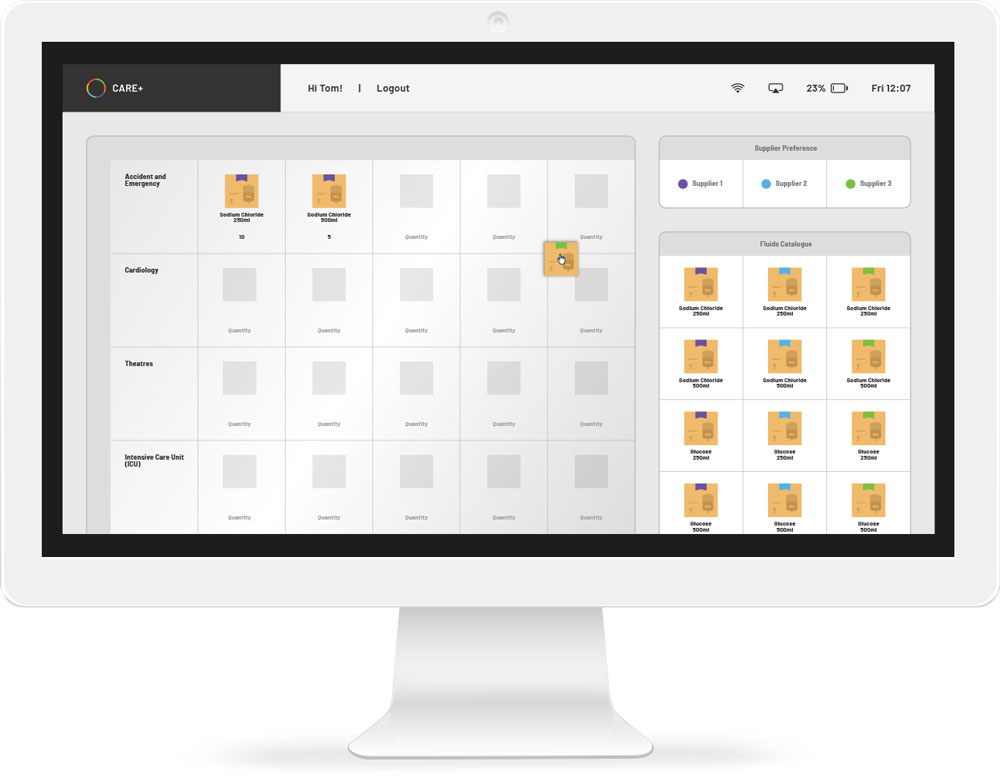
The Trust can define their product preference, 1, 2, 3. The HOSLO System includes GS1 ‘GTIN’ standards. It enhances the process of Product Preferencing, Rationalising and Standardising, with the benefit of enabling and disabling products at the Trust, hospital and department levels.
Where a new unidentified product arrives at the Trust, the system PDA will recognise this item as a non-catalogued line and ask for assistance.
Extending the Current Materials Management Catalogue
With a new system and digitally enhanced feature(s) catalogue in place, more products currently listed on the Trust’s eProcurement system can be transferred to the materials management catalogue. Extending the catalogue and also understanding the supplier lead times will further secure the controls around ordering, the current spends, order duplication and containing the system department data into one single source platform of information.
Trust procurement team have full control of the new materials management catalogue and, in turn, removes these items from being visible on the end users eProcurement catalogue (i.e. removing order duplication, transactional costs and excess overstocking).
The Future Adhoc/One Off ‘Top Up’ Order Requests (i.e. Branch Requests)
 Adhoc/One Off ‘Top Up’ Order Requests from clinical teams will dramatically reduce as the catalogue, and the number of direct alternatives listed in the catalogue will increase, thus reducing the need for the end user to contact the Eleanor service support desk and team. With a new catalogue and system in place, end users will receive further enhanced comms from the Eleanor service desk, such as:
- Provide the end user with live information on when their current product/order is due to arrive
- Which products are listed in their catalogue, and any items that have been excluded
- What products were scanned when they last visited the department
- Advise whether the new product they are requesting has ever been used before within the Trust
- Whether the product is on the Trusts ‘approved’ catalogue and,
- Whether this requested item will need to be sent to the ‘Trust Supply Chain team’ for catalogue approval before they can add the item to their catalogue.
Stock ‘PAR’ Levels – (Prevention Against Run Out)
The hospital department catalogues contain all the current stock ‘PAR’ levels, including an audit on when and why PAR levels have been changed against a particular product. Making PAR-level changes is incredibly easy and can be amended individually or as a mass upload.
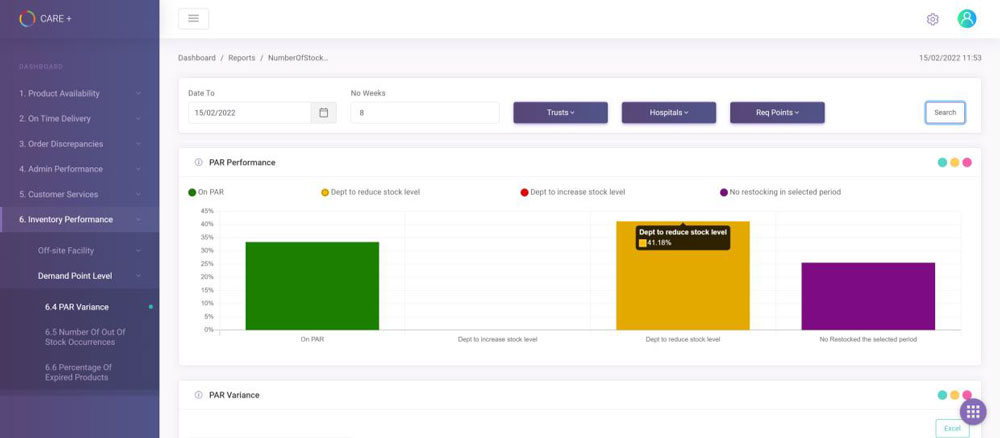
The HOSLO system is linked to a HOSLO service performance dashboard containing multiple KPI and SLA modules, one of which is a ‘demand point level’ PAR Variance. This feature alone has been a huge success on the NWLK Pharmacy fluids contract as the system can track all the short, medium and long-standing demands for each hospital department product, indicating whether the PAR levels should remain as they are (green–accurate), be increased (red), reduced (Amber) or potentially removed from the store (Purple).
This online system access feature contains all the ‘restock demand’ data over your selected weeks, including each product line’s current PAR price value. The system allows clear visibility and enables Eleanor to change PAR levels in line with demand and, in most cases, without consultation with the end users.
Bar-code Labelling
The process of updating, producing and adhering to NHS Supply Chain (EDC System) Bar-codes labels to storeroom stock bins is an extremely manual and time-consuming process and, at times, impossible to stay on top of with ongoing disruption to the supply chain. When any product stock PAR level requires a positive or negative level adjustment or a new/temporary replacement product is required for a particular department, the bar-code must be updated within the NHS Supply Chain’s EDC system (NHSSC) and a new label printed, laminated, applied to each storage location position within the department and old labels removed.
Given the high volume of discontinued NHSSC products in short supply and unquantifiable timelines for re-supply, managing the existing department catalogue and locating suitable direct and/or indirect replacements has become a minefield and, at times, an almost impossible task.
Therefore, producing labels and changing these over within the departments has become an impossible task. Available and suitable products are changing daily, NHSSC lead times are never truly known, and Trust Supply Chain teams may at times have to review over 10 product codes or more to find a product replacement, and with a distinct lack of confidence on how long the revised item will be available for. Extensive ‘clinical’ end-user survey results also highlighted that labels are not positively met before and after the survey.
The HOSLO system eliminates having to produce labels, simplifies difficult processes such as product preferencing, rationalising and standardising and allows the trust to disable and enable product codes at Trust, hospital and department level.
- Capture and monitor multiple supplier codes in one storeroom
- Assign Product preferences
- Rationalise and standardise products
- Disable products by Trust, hospital and department
- Ability to recognise all bar code types or generate own
- Recognise all ‘outer’ and ‘inner’ product carton barcodes
- Capture price of each product
- Set up PAR levels and auditable changes
- GTIN system fields to capture GS1 product identification standards.


